Fact statements
August 31, 2026The Israelization of Education in East Jerusalem
From Curriculum Modification to the Expanded Imposition of the Israeli Curriculum on Tens of Thousands of Palestinian Students
The Israelization of Education in East Jerusalem
From Curriculum Modification to the Expanded Imposition of the Israeli Curriculum on Tens of Thousands of Palestinian Students
An Unprecedented Development Since the Occupation of East Jerusalem in 1967
45,000 Palestinian students in East Jerusalem to study under the Israeli curriculum during the new academic year
31 August 2026 – Human Rights Report
The Palestinian education system in East Jerusalem is undergoing a rapidly accelerating transformation with the beginning of the 2026–2027 academic year, amid accumulated Israeli policies aimed at expanding the use of the Israeli curriculum in Palestinian schools and linking the establishment and official recognition of new schools and classrooms to the teaching of that curriculum
These measures are taking place alongside other policies affecting Palestinian teachers, educational institutions, and schools operated by the United Nations Relief and Works Agency for Palestine Refugees in the Near East (UNRWA)
Although these policies have been developing for years, the latest data indicate that they are now entering a broader and more institutionalized phase
First: 45,000 Students to Study Under the Israeli Curriculum
According to a report published by Haaretz and cited by Palestinian media on the morning of 31 August 2026, approximately 45,000 Palestinian students in East Jerusalem are expected to study under the Israeli curriculum during the new academic year. They represent approximately 38% of the nearly 120,000 Palestinian students in East Jerusalem
The most significant aspect of the report, however, is not the number alone. According to information attributed to Haaretz, all newly opened first- and seventh-grade classes in East Jerusalem municipal schools this year will adopt the Israeli curriculum. This has been described as an unprecedented development since the occupation of East Jerusalem in 1967
This does not mean that the Israeli curriculum is being introduced for the first time; it has been taught for years. Rather, the new development, according to the report, is the policy of applying the Israeli curriculum to all newly opened classes in the specified grades within the municipal school system
Published data indicate that the number of students studying under the Israeli curriculum in municipal schools has risen from 10,347 in the 2020–2021 academic year to 39,363 in the new academic year, while the total number expected across various educational institutions is approximately 45,000 students
Second: Official Israeli Data Confirm the Trend
On 5 January 2026, the Israeli Ministry of Education informed the Knesset subcommittee dealing with educational curricula in East Jerusalem that 36% of students in East Jerusalem were studying under the Israeli curriculum. The meeting was devoted to monitoring the implementation of Government Resolution No. 880
On 17 May 2026, the Knesset Education Committee also conducted a tour of educational institutions in East Jerusalem. Its official statement noted a significant increase in the adoption of the Israeli curriculum and quoted the Director of the Jerusalem District at the Ministry of Education as describing the shift toward the Israeli curriculum in recent years as a “revolution”
In May 2025, the Knesset had also documented the opening of dozens of classes operating under the Israeli Ministry of Education curriculum and an increase in the number of students taking the Israeli Bagrut matriculation examinations
These data make it difficult to view the August 2026 development as an isolated decision. Rather, it forms part of an organized and gradual governmental process
Third: Israeli Government Resolution No. 880
Government Resolution No. 880, adopted in August 2023, is a central element in understanding this policy
The resolution launched the second five-year plan for 2024–2029, under the stated objective of reducing socioeconomic disparities in East Jerusalem. Repeated Knesset meetings throughout 2025 and 2026 demonstrate that implementation of the resolution, including its education component, remains subject to continuous governmental and parliamentary oversight
Ir Amim provides a more critical assessment of the plan. According to its annual report on education in East Jerusalem, the plan includes the construction of 1,204 new classrooms. However, according to the organization, the Ministry of Education and the Jerusalem Municipality have stipulated that new schools funded under the plan must be official schools operating under the Israeli curriculum
Fourth: The Classroom Shortage Becomes a Human Rights Issue
This condition takes on particular significance because of the chronic shortage of classrooms in East Jerusalem
According to municipal data obtained by Ir Amim, the shortage stands at 1,461 classrooms. Although the five-year plan provides for the construction of 1,204 new classrooms, only 20 new classrooms had been added by the year covered in the organization's report
Ir Amim argues that conditioning the establishment of new schools on the adoption of the Israeli curriculum effectively uses the urgent need for schools and classrooms as a means of pushing the Palestinian education system toward the Israeli curriculum. The organization describes this as a mechanism of pressure and coercion that undermines the autonomy of the Palestinian education system
This raises a fundamental human rights concern: when an area suffers from a severe classroom shortage and the construction of new schools and classrooms becomes conditional upon the adoption of a particular curriculum, the issue of “curriculum choice” can no longer be separated from effective access to education
Fifth: Measures Affecting Teachers with Palestinian Academic Degrees
The changes are not limited to school curricula
On 24 February 2026, the Association for Civil Rights in Israel (ACRI), acting on behalf of a group of petitioners, filed a petition with the Israeli Supreme Court seeking to overturn a law that prohibits the employment of teachers holding academic degrees from higher education institutions affiliated with the Palestinian Authority and prevents them from obtaining teaching licenses
The petitioners also requested an interim order preventing the law from taking effect pending a final ruling
The potential impact is particularly significant in East Jerusalem. According to official data cited by ACRI, approximately 60% of teachers in the East Jerusalem education system obtained their bachelor's degrees from universities in the West Bank. ACRI therefore argues that the law could exacerbate the existing shortage of educational personnel
Sixth: Closure of UNRWA Schools in East Jerusalem
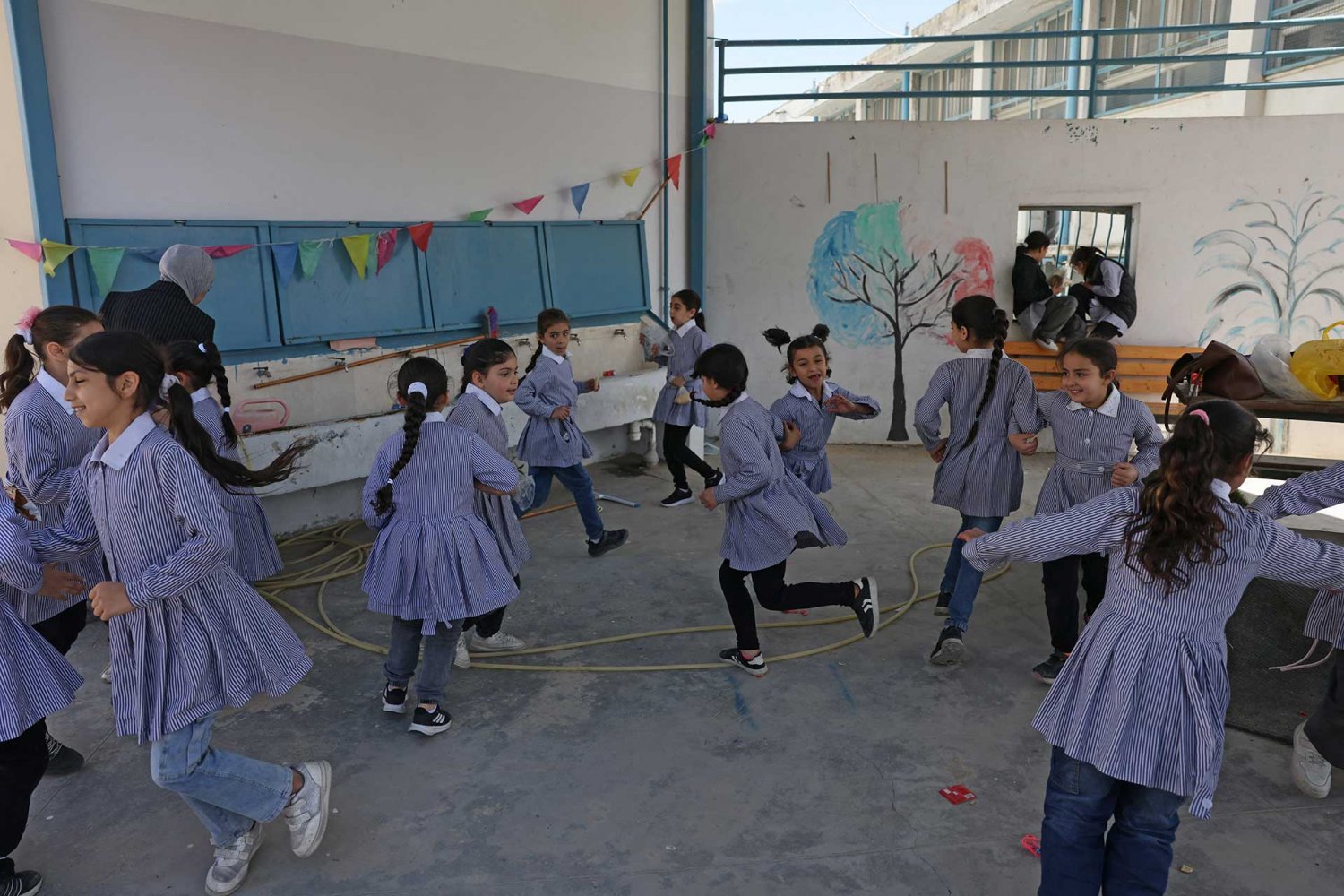
The expansion of the Israeli curriculum intersects with another major development: the closure of UNRWA schools in East Jerusalem
UNRWA states that the Israeli authorities closed six UNRWA schools in East Jerusalem in May 2025, affecting approximately 800 Palestinian children. In September 2025, the Agency stated that, for the first time in its history, it was unable to reopen its schools in East Jerusalem at the beginning of the academic year
The United Nations Office for the Coordination of Humanitarian Affairs (OCHA) has likewise confirmed that the six schools remained closed and that approximately 800 students were affected
In January 2026, UNRWA warned that “the United Nations presence in occupied East Jerusalem is shrinking rapidly,” following additional Israeli measures affecting its health centre, facilities, electricity and water services. The Agency reiterated that occupied East Jerusalem is not under Israeli sovereignty
In a subsequent legal statement, UNRWA said that Israeli authorities had implemented amendments to legislation targeting the Agency, including the closure of the six schools. It further stated that on 20 January 2026, Israeli authorities entered the premises of UNRWA's West Bank Field Office and demolished buildings there
Seventh: What Does the United Nations Say
OCHA has noted that new laws and legislative initiatives during the 2024–2025 academic year began reshaping the educational landscape in East Jerusalem, drawing on reporting by Ir Amim
OCHA recorded that newly established schools were being required to adopt the Israeli curriculum at a time when the education sector faced a shortage of approximately 1,460 classrooms, alongside the closure of the six UNRWA schools
This is an important point from a documentation perspective, as it moves the issue beyond local and Israeli reporting into the sphere of official United Nations humanitarian monitoring
Eighth: International Legal Assessment
From a legal perspective, it is important to avoid automatically asserting that the mere teaching of an Israeli curriculum constitutes, in itself, a “war crime.” The legal question is more complex
The United Nations considers East Jerusalem to be part of the Occupied Palestinian Territory and does not recognize Israel's annexation of the area. Israeli educational measures there must therefore be examined within the framework of the law of occupation, international humanitarian law and international human rights law
Among the most relevant legal provisions are
Article 50 of the Fourth Geneva Convention, which requires the occupying power to facilitate the proper working of institutions devoted to the care and education of children
Article 27 of the Fourth Geneva Convention, concerning respect for protected persons and their fundamental rights
Article 13 of the International Covenant on Economic, Social and Cultural Rights (ICESCR), which protects the right to education
From a children's rights perspective, Articles 28 and 29 of the Convention on the Rights of the Child (CRC) are particularly relevant. Article 29 links education, among other considerations, to the development of the child's cultural identity, language and values
Accordingly, the human rights question is not limited to “Which curriculum is educationally better?” It also concerns whether the occupying power is using funding, infrastructure, licensing requirements, restrictions on teachers, and the closure of educational institutions to move the protected population away from its own educational system and cultural identity
Ninth: What Can Be Documented at This Stage
Based on the sources available as of 31 August 2026, the report identifies the following interconnected developments
Approximately 45,000 Palestinian students are expected to study under the Israeli curriculum in East Jerusalem during the new academic year, according to the report attributed to Haaretz
All newly opened first- and seventh-grade classes in municipal schools will adopt the Israeli curriculum, according to the same report
The Israeli Ministry of Education stated in January 2026 that 36% of East Jerusalem students were studying under the Israeli curriculum
Government Resolution No. 880 provides the principal governmental framework for the current five-year plan
Ir Amim documents the requirement that newly established schools funded under the plan teach the Israeli curriculum, against the backdrop of a shortage of 1,461 classrooms
Another Israeli law affects the employment of graduates of Palestinian universities in the education system and has been challenged before the Israeli Supreme Court
Six UNRWA schools in East Jerusalem were forcibly closed, affecting approximately 800 students
OCHA has documented how these developments are connected to the reshaping of the educational environment in East Jerusalem
Human Rights Conclusion
The figure of 45,000 students should not be viewed in isolation from this broader context. The issue extends beyond changes to school textbooks and involves the interaction of several mechanisms: curricula, funding for new schools, classroom construction, the Israeli Bagrut matriculation system, regulation of teachers' employment, recognition of Palestinian academic qualifications, and the closure of UNRWA educational institutions
Taken together, these measures point to a gradual transformation of the institutional structure of Palestinian education in East Jerusalem
While the Israeli authorities describe the plan in terms of reducing disparities, improving education and promoting integration, human rights organizations such as Ir Amim and the Association for Civil Rights in Israel (ACRI) argue that aspects of these policies undermine the autonomy of Palestinian education and affect the rights of Palestinian students as well as their educational and cultural identity