
Fact statements
September 4, 2026Needs Senate Approval and the President’s Signature Before Becoming Law
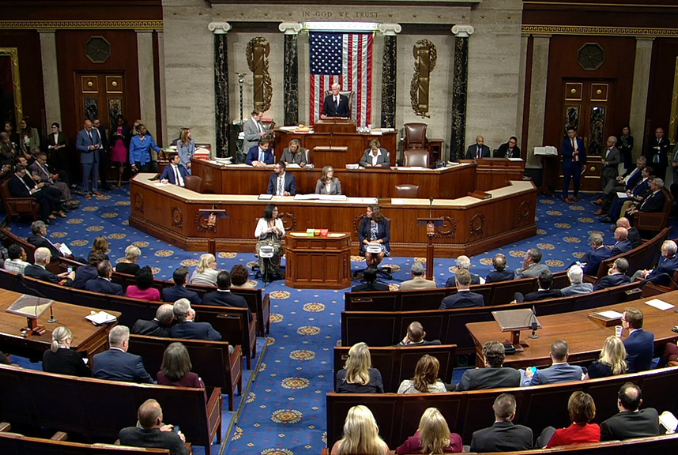
U.S. House Passes Bill to Penalize Universities Participating in Boycotts of Israel
Needs Senate Approval and the President’s Signature Before Becoming Law
U.S. House Passes Bill to Penalize Universities Participating in Boycotts of Israel
4 September 2026
On 3 September 2026, the U.S. House of Representatives passed the Protect Economic and Academic Freedom Act (H.R. 4795) by a vote of 237–169, in a move that could deny colleges and universities access to major federal aid and funding programs if they participate in commercial boycotts against Israel or impose restrictions on academic exchanges with Israeli institutions. The bill must still pass the Senate and then be signed by the President before it becomes law
The vote revealed a notable shift within the Democratic Party. 167 Democrats opposed the bill, while only 33 supported it, whereas 203 Republicans voted in favor and only two opposed it. Opponents argue that the measure threatens freedom of expression and academic freedom and could, in practice, extend to boycotts related to Israeli settlements in the occupied West Bank. Supporters, by contrast, say the bill targets discrimination against Israeli institutions and students and does not prohibit political expression itself
?What Does the Bill Provide
The bill would amend the Higher Education Act and impose conditions on colleges and universities that benefit from federal funding programs
According to the Congressional Budget Office (CBO), educational institutions would be required not to participate in what the bill calls “nonexpressive commercial boycotts” against Israel or against entities that are organized, licensed, or otherwise subject to Israeli law
This could include, for example, refusing to engage in business or terminating commercial relationships for the purpose of limiting ties with Israel, unless there is a legitimate business justification
Violation of these conditions could result in the institution losing eligibility to participate in federal student aid programs, including Pell Grants and federal student loans
The bill also imposes restrictions related to academic boycotts. Universities benefiting from certain international education and foreign-language programs would have to certify annually that they do not unreasonably prevent their students and faculty members from participating in academic programs in Israel and that students and academics from Israeli institutions are treated in a manner comparable to those affiliated with other foreign universities.
Accordingly, the phrase “a ban on federal funding for universities that boycott Israel” is broadly accurate, but somewhat wider than the bill’s precise wording. The measure would not automatically withdraw every federal dollar from a university. Rather, it would make eligibility for certain major forms of federal higher-education funding conditional on compliance with these requirements
A Clear Division Within the Democratic Party
:The official vote tally was
237 in favor — 169 opposed
Among Republicans, 203 members voted for the bill, while only two voted against it
Among Democrats, 33 voted in favor and 167 voted against
One independent member also supported the bill
This means that approximately 83.5% of Democrats who voted opposed the bill, while roughly 16.5% supported it
There is therefore a clear basis for describing the vote as reflecting a significant internal political divide within the Democratic Party over Israel, although the phrase “a critical position” would be a media characterization rather than an official description of the vote
Notably, House Democratic Minority Leader Hakeem Jeffries opposed the bill despite reiterating his opposition to the BDS movement. He argued that the measure was poorly drafted and could give the Trump administration the ability to pursue politically motivated punitive actions against universities
Prominent Democratic Representative Jerrold Nadler, who is also an opponent of BDS, likewise voted against the bill, arguing that it raises serious concerns regarding freedom of speech and the First Amendment to the U.S. Constitution.
By contrast, Democratic Representative Josh Gottheimer was one of the bill’s leading sponsors alongside Republican Representative Virginia Foxx. He defended the legislation by arguing that universities receiving taxpayer funds should not discriminate against Israeli academic institutions or partnerships.
?What About Israeli Settlements
This is one of the most legally and politically controversial aspects of the bill.
The language does not simply refer to companies or universities located within Israel’s internationally recognized borders. Rather, it extends to entities that are “organized, licensed, or otherwise subject to Israeli law.”
Critics therefore warn that the measure could also apply to companies or institutions operating in Israeli settlements in the occupied West Bank.
Coverage by the Times of Israel likewise noted that Democratic leaders objected to the fact that the definition of boycott is broad enough to encompass both Israel and settlements in the West Bank, even though the overwhelming majority of the international community considers the settlements illegal under international law.
This is a particularly important point from a human-rights perspective. If the bill becomes law in its current form and is interpreted in this way, a U.S. university could potentially face the risk of losing federal funding if it adopts a policy distinguishing between Israel and commercial or academic activity connected to settlements in the occupied Palestinian territory.
Civil-Liberties Objections Concerning Free Speech and Boycotts
U.S. civil-rights organizations strongly criticized the bill.
The American-Arab Anti-Discrimination Committee (ADC) described it as an attack on freedom of speech, academic freedom, and the long-standing American tradition of using boycotts as a form of political protest.
The Council on American-Islamic Relations (CAIR) also urged the Senate to reject the bill, arguing that threatening universities with the loss of educational aid when they adopt politically motivated boycott decisions raises constitutional concerns related to freedom of expression and political association.
Supporters of the legislation, however, argue that it does not target the expression of political views or political protest itself, but rather the university’s institutional and commercial conduct. They say its purpose is to prevent what they regard as discrimination against Israeli students, academics, and institutions and to combat antisemitism on university campuses.
The House Committee on Education and the Workforce presented the bill in precisely these terms.
Legislative Background
Republican Representative Virginia Foxx originally introduced the bill in July 2025, with Democratic Representative Josh Gottheimer among its leading co-sponsors.
The bill was subsequently approved by the House Committee on Education and the Workforce and sent to the full House. The committee’s official report, H. Rept. 119-780, was issued on 27 August 2026, ahead of the final House vote.
The Congressional Budget Office (CBO) estimated that the bill’s direct federal budgetary impact would be limited because it expects universities to comply with the new requirements rather than risk losing their eligibility for federal funding
End